
Having an executive-level background in product safety/regulation, as well as having been a business owner and adjunct professor, certain legislation in North Carolina that would increase public exposure to guns at businesses, educational institutions, as well as restaurants and bars that serve alcohol, caught my attention. It is difficult to understand how such legislation would promote the well-being and safety of our citizenry.
Our government regulates products because of our constitution’s charge that its actions promote the general welfare, i.e., our well-being. As a result, many products as well as such things as our air, water and financial institutions are regulated for the protection of our citizenry. Regulatory agencies, e.g., the SEC, FDA, and EPA, were created, in part, to monitor and assure compliance with such legislation.
The pull and tug between business and regulation is well known with business typically looking to reduce regulation to its benefit through lobbying efforts and, yes, financial contributions to legislators. Regrettably, all too often it takes a disaster to put meaningful, and frankly common sense, regulation in place. With drug products, the regulated industry where I spent my career, it was the Elixir of Sulphanilamide in 1937 that killed over 100 citizens through poisoning that resulted in the requirement drugs be shown safe before marketing. And following the thalidomide tragedy, it was the Kefauver-Harris Amendment in the early 1960’s that required drug products be proven effective prior to marketing.
When it comes to product regulation, however, guns exist in a separate world. There is little question that there are public safety issues concerning guns, yet attempts to regulate this product are met with cries of impinging individual liberties and freedoms, even when confronted with such highly publicized shootings as those at Columbine High School and Virginia Tech where multiple young lives were lost in both. As an example and despite those horrific events, recent legislation that passed the House in North Carolina would have allowed students with concealed carry permits to keep guns locked in their cars on campus. Frankly, the thought of conducting a performance review with a student who had access to loaded weapon nearby was a bit frightening, as would be the presence of loaded weapons on campus with the alcohol consumption we know occurs as part of the college experience. That provision was, thankfully, later removed from the legislation.
Another piece of pending legislation, House Bill 111, would permit individuals with concealed carry permits to bring loaded weapons into restaurants and bars (at least those where the owner agrees) that serve alcohol. Ethanol, the type of alcohol we drink, is a psychoactive substance and a legally permitted recreational drug. It interacts with multiple neurotransmitter systems and is behavior modifying. The substance can produce impaired judgment as well as emotional lability, i.e., excessive mood swings ranging from rage to euphoria. Law enforcement officials are all too familiar with alcohol-related violent behavior. The picture selected for this article, reproduced below, is that of a ‘drunken brawl’ at a high society event where the participants were using whatever they could get their hands on, including bottles and furniture, to inflict harm to others.
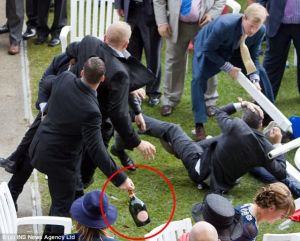
The mixing of both guns and alcohol consumption in a public setting raises several safety issues.
First, citizens who consume alcohol at bars or restaurants, some of whom will exhibit poor judgment in what they say as well as some who will exhibit volatile and aggressive behavior, may do so in the presence of individuals carrying concealed loaded weapons.
Second, although law prohibits those with concealed carry permits from alcohol use while carrying their weapon, there will be those who will violate law. Last year, for example, an executive with a gun permit, who was returning from a strip club, was found to be intoxicated and carrying a loaded and cocked gun on his hip at a DUI checkpoint (ref). Additionally, there have been instances where police officers, individuals who have sworn to uphold the law, have discharged a gun while intoxicated; one being with the Dallas Police who pulled a revolver from an ankle holster (ref) and another, just this month, in South Carolina who discharged a firearm into a dwelling while driving and intoxicated (ref). Additionally, a recently published study from University of California Davis has shown that gun owners who carry concealed weapons or have confronted another person with a gun are more than twice as likely to drink heavily as people who do not own guns (ref) (ref). And despite repeated claims during the debate on ‘guns in bars’ legislation by Tennessee State Representative, Curry Todd (the sponsor of the legislation that became law in Tennessee) that no responsible gun owner would ever carry his gun while drinking, this past year he was found intoxicated while driving and in possession of his gun (ref). There should be little doubt that HB 111, should it become law, would result in instances of individuals carrying concealed weapons while under the influence of alcohol in eating and drinking establishments where our citizens are present, simply because of the unwillingness of some to follow law.
And third, restaurants and bars are places of employment and employers are required under both state and federal law to provide a workplace that is free from recognized hazards that can cause death or serious physical harm to employees, and by extension to guests of that business. Alcohol-related violence is a well known workplace hazard in these establishments. And there is nothing in the legislation that would prevent an employee from bringing concealed gun into that place of business; I seriously doubt that many establishment owners would feel comfortable taking disciplinary action or terminating employment with an individual holding a loaded weapon. In such a situation that employee could become a safety threat to management, other employees, and even patrons of the establishment. An owner that allows loaded weapons into that environment on a day-to-day basis can only increase the likelihood of firearm discharge, perhaps even an exchange of gunfire, within a business placing both employees and patrons at risk.
It has been argued that the presence of loaded weapons in restaurants and bars would make the businesses safer. It is difficult to imagine an individual attempting to make the argument before a regulatory body that increasing public exposure to a potentially dangerous product would improve safety. Regulatory action typically moves in the opposite direction to reduce exposure and thus the opportunity for problems.
It has additionally been argued that concealed weapons have been permitted in restaurants and bars in several other states without problems. Such an argument is invalid regarding safety because the issue is not the history; it is the potential. In fact it is this very mind set that often prevents common sense regulation from being put into place that later results in loss of life or damage to our public. As examples, should we conclude after several years without incident that a blocked exit does not pose a safety risk? Or, CFTC’s Brooksley Born’s failed attempt to regulate and bring transparency to OTC derivatives in the late 1990’s at the hands of free market ideologues and Wall Street lobbyists that, 10 years later, brought corporate giants like AIG to their knees at taxpayer expense?
And finally, if the provision to keep guns locked in cars at a place of business was recently removed from proposed legislation, one would have to question the logic as well as the judgement of North Carolina legislators if they pass legislation that would actually permit loaded weapons within a place of business.
There is no question that citizens have the right to own firearms in this country. But should that Second Amendment right be used to justify assault weaponry that places both citizens and law enforcement officers at risk, or have our markets arm the Mexican drug cartels or anti-government extremist groups such as Michigan’s Hutaree to the financial benefit of an industry with a powerful lobbying group? Or at a town hall meeting on healthcare, should our public have to face an individual carrying a holstered weapon and a sign saying “Its time to water the tree of liberty” (from a Jefferson quote where the watering is done with blood)? That, frankly, is intimidation and interferes with our First Amendment right to peaceably assemble and have our say. Contained in the Second Amendment is the term ‘well-regulated’ and the right of citizens to own firearms should not trump our government’s purpose to promote our well-being and enact common-sense regulation for those products just as it does for others.
And lawmakers in North Carolina can begin with House Bill 111. Certain things just don’t mix well, and one of them is guns and alcohol.
 Art on Issues
Having worked as a waitress many years ago I know how mad people can get over “nothing.” Now instead of yelling are they going to pull a gun a shoot? Do Moms & Dads want there children in a close proximity to a gun totting patron when there kid has a temper tantrum? Does a server have to die before Politicians wake up?
LikeLike
I agree. A legislator in this state, when asked if wait staff should be able to ask if a patron who was ordering alcohol was carrying a concealed gun, replied that it was not the role of wait staff to serve as police. I believe many of us have witnessed angry patrons who were displeased with service, or a bartender (a highly at-risk job) who refused to continue serving – generally an unpleasant and volatile scene. Now, do we really want to introduce a product whose intended use is to inflict serious bodily harm or death into that environment? This is not about constitutional rights; it is about the well-being of our citizenry and the role of our government in promoting our general welfare – our well-being.
LikeLike
Does the proposed law here allow someone to get drunk while carrying, or does that remain illegal?
Is there something about your state’s license holders that makes them more likely to commit armed violence than the other 40 or so states that allow sober people with legally carried guns to eat in nice restaurants?
Have these ‘blood in the streets’ predictions about all aspects of licensed concealed carry ever come true?
LikeLike